

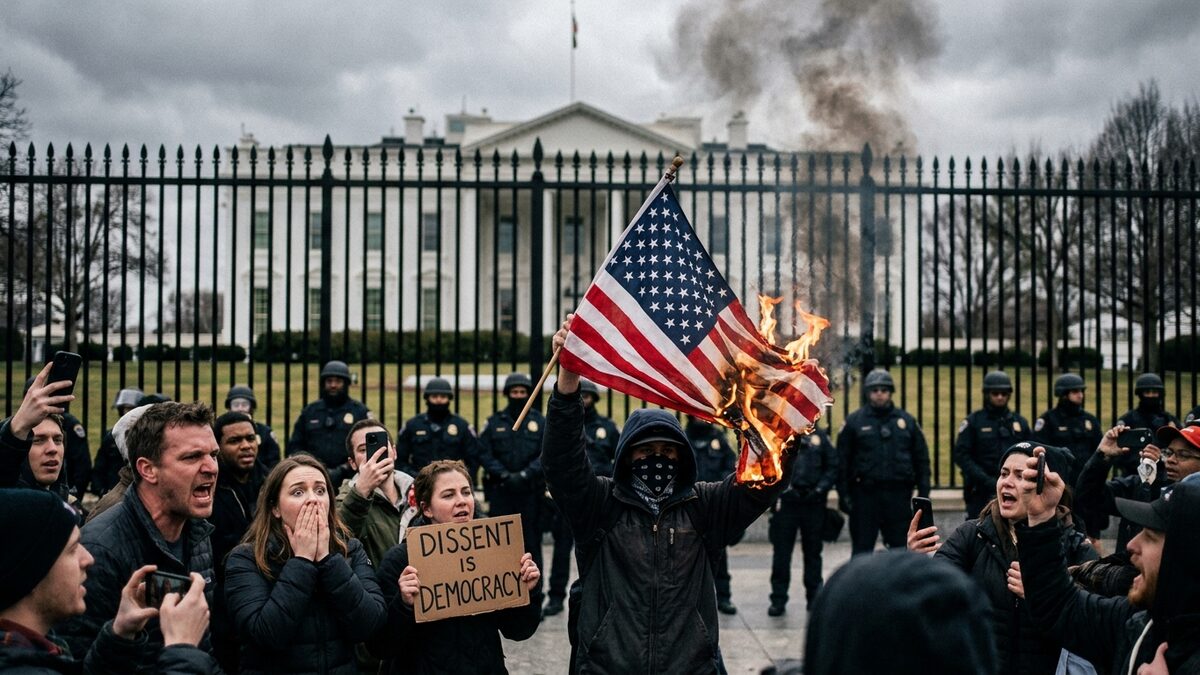
The recent flag-burning protest at Lafayette Square has reignited a contentious national debate over the boundaries of free expression and the legal protections afforded to the American flag. With nearly 1,500 such incidents reported over the past decade, this surge challenges existing legislation. Former President Donald Trump’s call for stricter penalties underscores the symbolic weight of the flag and raises critical questions about balancing patriotism with constitutional rights.
Key Takeaways
- Nearly 1,500 flag-burning incidents have occurred in the U.S. over the past decade, raising free speech concerns.
- A man was arrested for burning a flag in Lafayette Square shortly after President Trump issued a related executive order.
- Trump is pushing for stricter penalties on flag desecration, claiming current laws are insufficient.
- Lafayette Square’s federal jurisdiction enabled a prompt law enforcement response to the protest.
Nearly 1,500 flag-burning incidents have been reported across the United States in the past decade, a surge that has reignited debate over the limits of free expression. This wave of protests has captured national attention as former President Donald Trump advocates for stricter penalties, arguing that current laws fail to adequately protect the American flag’s symbolic value.
Flag-Burning Protest at Lafayette Square
On Monday evening, a man was arrested after burning a U.S. flag in Lafayette Square, the federal parkland directly across from the White House. The protest occurred just hours after President Trump issued an executive order aimed at tightening enforcement against flag desecration. Authorities detained the individual following the incident, which was widely reported as a deliberate act of protest against the new policy rather than a spontaneous disturbance.
Nearly 1,500 flag-burning incidents have been reported across the United States in the past decade, a surge that has reignited debate over the limits of free expression.
The location of the protest is significant because Lafayette Square falls under federal jurisdiction, where specific rules apply that differ from those governing ordinary city streets. This federal oversight allowed law enforcement to respond swiftly in line with the heightened focus on flag-related offenses introduced by the administration.
Details of Trump’s August 25 Executive Order
On August 25, 2025, the White House released an executive order titled “Prosecuting Burning of The American Flag.” The directive calls on the Attorney General to prioritize enforcement of existing criminal and civil statutes against flag desecration, provided those laws are content-neutral and address conduct rather than protected speech. The order highlights statutes related to violent crimes, hate crimes, illegal discrimination, property crimes, and breaches of the peace.
Additionally, federal agencies are instructed to refer possible violations of relevant state or local laws—such as open-burning restrictions, disorderly conduct, or property destruction—to local authorities. The order also signals an intention to pursue litigation aimed at narrowing or clarifying First Amendment exceptions concerning flag desecration, potentially reshaping the legal landscape surrounding this form of protest.
Immigration Enforcement Linked to Flag Desecration
Trump’s executive order extends beyond criminal prosecution to address immigration consequences for foreign nationals involved in flag-desecration activities. The Secretary of State, Attorney General, and Secretary of Homeland Security are directed to use their respective authorities to impose penalties on non-citizens who participate in such conduct when it falls under federal jurisdiction. This marks a novel approach linking flag desecration with immigration enforcement, underscoring the administration’s broader strategy to deter these acts through multiple legal avenues.