

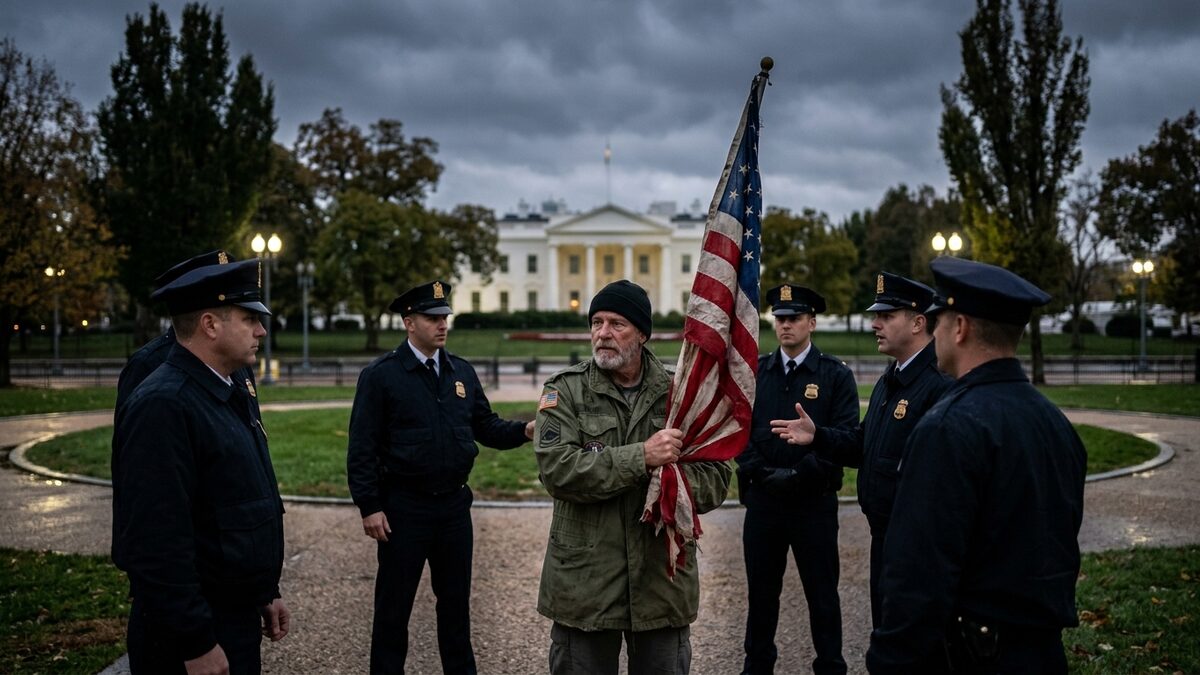
The recent protest by Vietnam War veteran Jan Carey, who burned an American flag near the White House, has ignited a fervent national debate on the intersection of free speech and patriotism. This incident, occurring under newly enforced flag-desecration laws, challenges the boundaries of legal authority and individual rights on federal property. The unfolding discourse raises critical questions about the balance between symbolic expression and respect for national symbols.
Key Takeaways
- The veteran’s flag-burning protest near the White House led to immediate arrest under new flag-desecration laws.
- The incident sparked a national debate about the limits of free speech and respect for the American flag.
- The protest was a direct challenge to an executive order signed by President Trump restricting flag burning.
- Security forces acted quickly to enforce the intensified crackdown on flag desecration in a highly symbolic location.
On a brisk morning outside the White House, a Vietnam War veteran knelt solemnly on the lawn, holding a tattered American flag aloft before setting it alight in a silent act of protest. The veteran’s quiet defiance quickly drew the attention of security personnel and sparked an immediate crackdown under newly intensified flag-desecration laws. This incident has since ignited a heated national debate over the boundaries of free speech and the symbolism of the American flag.
The Protest on White House Grounds
On Monday, August 25, 2025, Jan Carey, a 54-year-old Army veteran from Arden, North Carolina, ignited an American flag near Lafayette Park, the public green space adjacent to the White House. The park, managed by the National Park Service, has long been a site for public demonstrations. Carey’s act was a direct response to an executive order signed earlier that day by President Donald Trump targeting flag burning. Video footage captured Park Police or Secret Service agents swiftly intervening and taking Carey into custody following the flag burning.
The veteran’s quiet defiance quickly drew the attention of security personnel and sparked an immediate crackdown under newly intensified flag-desecration laws.
The protest was notable not only for its timing but also for its symbolism. Carey’s peaceful but provocative gesture drew immediate media attention and became a focal point in discussions about patriotism, protest, and the limits of free expression on federal property. Multiple news outlets highlighted the veteran’s motives, emphasizing his opposition to the new federal directive aimed at curbing flag desecration.
Federal Charges and Legal Proceedings
Following the incident, federal prosecutors in Washington, D.C., charged Carey with two misdemeanor counts rather than a direct flag-desecration offense. The charges cited starting a fire in an unauthorized location and igniting a fire that caused damage to property or park resources within Lafayette Park. According to CBS News, one count specified that the fire was lit “not in a designated area and receptacle,” while the other addressed the threat or damage caused to park property and resources.
The alleged violations carry penalties including fines or imprisonment for up to six months. Carey pleaded not guilty at his initial court hearing, setting the stage for a legal confrontation that will test the scope and enforcement of the new flag-burning policies. Legal experts have noted that while the charges circumvent a direct flag-desecration statute, they represent an effort to apply existing, content-neutral laws to regulate the protest.
Trump’s Executive Order and Its Implications
President Trump’s executive order, issued on the same day as the protest, directs the Justice Department to investigate and prosecute flag burning to the fullest extent permitted by law. The administration emphasized that prosecutions would focus on flag desecration acts that violate content-neutral regulations, particularly where the act causes harm unrelated to expressive conduct. The order instructed prosecutors to prioritize cases involving damage to property or threats to public safety, while remaining mindful of First Amendment protections.
The directive also called upon the Attorney General to develop guidelines for enforcing flag-desecration laws consistent with constitutional limits. This approach reflects an attempt to balance the administration’s stance on national symbols with the legal protections afforded to political expression. The flag-desecration crackdown following the veteran’s protest has thus become a litmus test for the administration’s policy and the judiciary’s interpretation of free speech boundaries in the context of symbolic acts on federal grounds.