

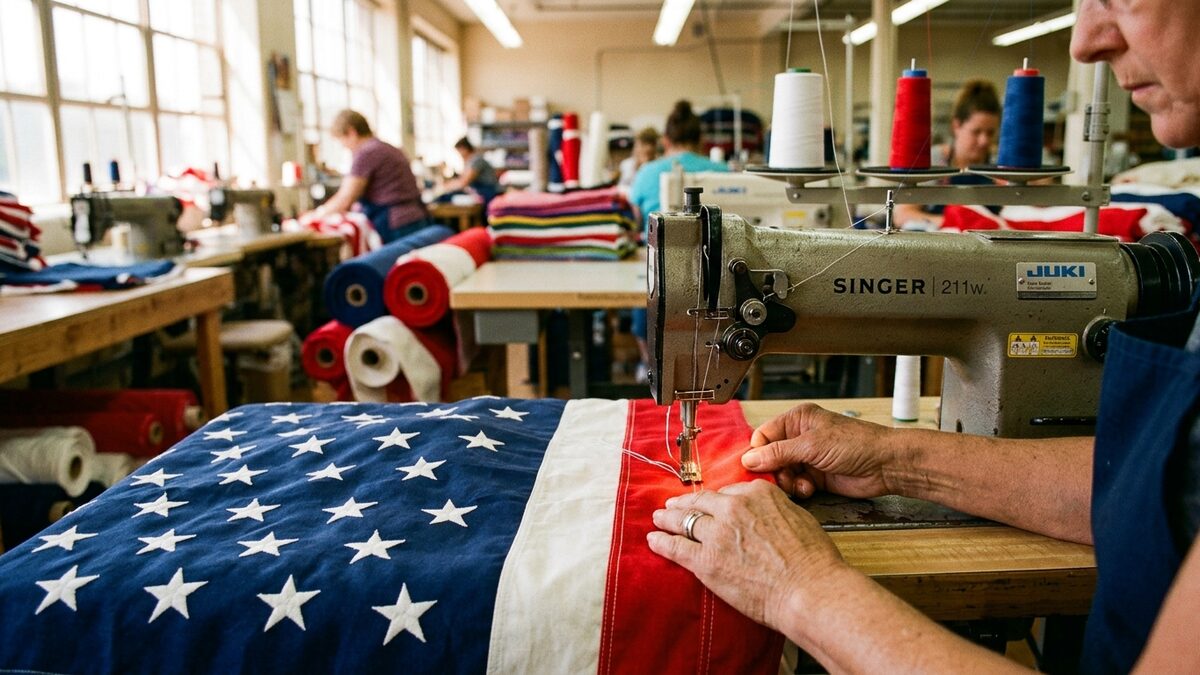
Recent legislative initiatives address the significant challenges faced by American flag manufacturers amid a sharp decline in domestic production caused by foreign-made flags falsely labeled as “Made in USA.” The All-American Flag Act, effective July 30, 2024, mandates that flags purchased by the federal government must be wholly produced within the United States. This move highlights a renewed commitment to protecting American jobs and ensuring authenticity in patriotic symbols.
Key Takeaways
- American flag production in the U.S. has declined by nearly 40% due to foreign-made flags with false "Made in USA" labels.
- The All-American Flag Act requires federal government-purchased flags to be fully made in the United States, including materials.
- This Act was passed by the Senate in November 2023 and the House in July 2024 to strengthen domestic manufacturing enforcement.
- The legislation aims to protect American jobs and uphold the authenticity of the national symbol.
Over the past decade, American flag manufacturers have seen domestic production plummet by nearly 40%, as foreign-made flags flood the market under misleading “Made in USA” labels. This dramatic decline has prompted new legislative efforts aimed at strengthening enforcement of country-of-origin labeling laws, safeguarding the integrity of American manufacturing, and preserving jobs in a sector deeply tied to national identity.
Federal Policy Foundation: The All-American Flag Act
The All-American Flag Act, enacted on July 30, 2024, represents the core federal legislative framework reinforcing the domestic manufacture of American flags. Codified at 41 U.S.C. § 6310 (Pub. L. 118-74), the Act mandates that flags purchased by the federal government must be fully manufactured in the United States, including the use of materials produced domestically. This comprehensive requirement ensures that both the production process and raw materials originate within the country.
Over the past decade, American flag manufacturers have seen domestic production plummet by nearly 40%, as foreign-made flags flood the market under misleading “Made in USA” labels.
The legislative journey of the Act saw Senate passage on November 2, 2023, followed by House approval on July 22, 2024. The bill was sponsored by Representative Eric Sorensen (IL-17) in the House, with Senators Sherrod Brown (D-OH) and Susan Collins (R-ME) leading the Senate effort. An exception within the statute allows for procurement flexibility when satisfactory quality or quantity cannot be obtained at market prices, balancing enforcement with practical considerations.
New Legislative Push: Make American Flags in America Act of 2025
Building on the All-American Flag Act, the Make American Flags in America Act (H.R. 1421) was introduced on February 18, 2025, by Representative Nicholas A. Langworthy (R-NY-23). The bill, referred to the House Judiciary and Energy and Commerce Committees, seeks to expand enforcement by prohibiting federal agencies from displaying or purchasing U.S. flags not made entirely in the United States.
This legislation aims to close existing loopholes that permit foreign-made flags to be marketed as American-made, thereby reinforcing the integrity of federal procurement policies. By linking federal flag display and procurement directly to domestic manufacturing, the bill strives to support American flag manufacturers and prevent mislabeling in the marketplace.
Closing Loopholes and Strengthening “Made in USA” Enforcement
The Make American Flags in America Act of 2025 explicitly targets the enforcement gaps undermining the “Made in USA” label reliability. According to the sponsor’s office, the bill ensures that flags displayed on federal property or purchased by government agencies are entirely manufactured in the United States from American-produced materials, effectively eliminating ambiguity surrounding origin claims.
These legislative efforts to protect American flag manufacturing amid “Made in USA” enforcement reflect broader concerns about preserving domestic manufacturing jobs and protecting national symbols from dilution through foreign imports. By tightening regulatory standards and procurement policies, Congress aims to restore confidence in the authenticity of American flags and support the industry that embodies national pride.