

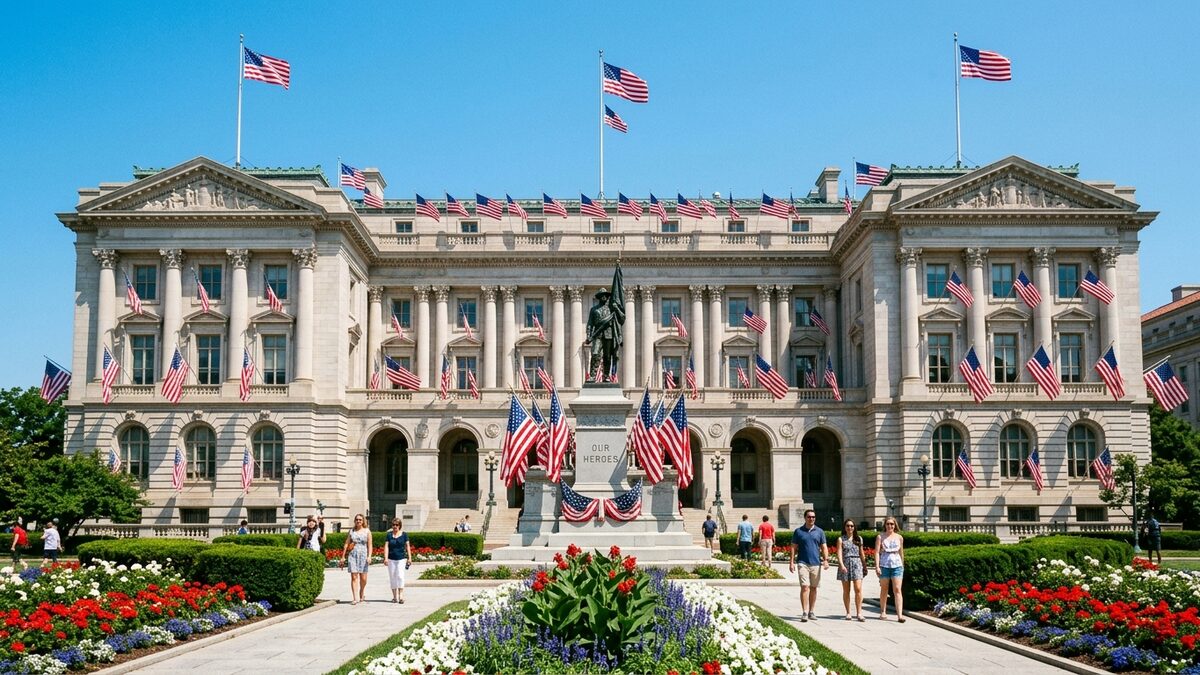
A growing nationwide initiative is prompting public buildings, parks, and monuments to prominently display the U.S. flag, underscoring its significance as a symbol of unity and national pride. From Boston to the Pacific Northwest, this movement seeks to strengthen collective identity during a time of social complexity. Exploring the implications of this widespread effort reveals how public spaces are shaping the conversation around patriotism and community cohesion.
Key Takeaways
- Public buildings, parks, and monuments nationwide are prominently displaying the U.S. flag to foster patriotism.
- The movement aims to use the flag as a unifying symbol amid social complexities.
- Historic and public sites across diverse regions are participating in this coordinated effort.
- The flag’s presence in public spaces is reaffirmed as a core element of American identity.
On a crisp morning in early June, the flag atop Boston’s City Hall was raised with renewed vigor, its stars and stripes catching the sunlight as residents paused in quiet respect. This simple gesture mirrored a growing movement across the nation, where public buildings, parks, and monuments have embraced the U.S. flag not only as a symbol of patriotism but as a unifying emblem amid a complex social landscape. From historic courthouses in the South to memorials in the Pacific Northwest, a coordinated effort is emerging to elevate the flag’s presence in public spaces, reaffirming its role in American identity.
Nationwide Emphasis on the U.S. Flag in Public Spaces
Across the United States, public buildings, parks, and monuments have increasingly become prominent sites for displaying the U.S. flag. This trend reflects a deliberate effort to use the flag as a visible symbol of national pride and unity, embodying the values and ideals foundational to the country. Locations such as government buildings, schools, town squares, plazas, and parks have all been designated as essential venues where the flag’s presence serves as a shared visual anchor for civic life and public ceremonies.
This simple gesture mirrored a growing movement across the nation, where public buildings, parks, and monuments have embraced the U.S. flag not only as a symbol of patriotism but as a unifying emblem amid a complex social landscape.
The flag’s display in these public arenas transcends mere decoration; it reinforces a collective identity and promotes social cohesion. As communities gather for events, celebrations, and remembrances, the flag provides a unifying emblem that connects diverse populations under the banner of American heritage. This resurgence in flag visibility speaks to a broader cultural recognition of the flag’s role in fostering a sense of belonging and continuity in the nation’s public life.
Legal Framework Supporting Flag Display at Public Institutions
The display of the U.S. flag at public institutions is underpinned by federal law and the U.S. Flag Code, which establish guidelines and expectations for its respectful presentation. According to 4 U.S. Code § 7, the flag is mandated to be displayed on federal buildings, grounds, and naval vessels under specified conditions, including observance of half-staff protocols during national mourning or remembrance. The Flag Code further stipulates that the flag should be flown from sunrise to sunset on buildings and stationary flagstaffs, unless illuminated properly during nighttime hours.
Moreover, the Code prohibits displaying the flag during inclement weather unless it is an all-weather flag, emphasizing respect and preservation of the symbol. The flag is also required to be displayed on or near the main administration building of every public institution, as well as in or near every polling place on election days and near every schoolhouse during school days. These provisions highlight the flag’s integral role in civic rituals and underscore its importance in democratic processes and educational environments.
GSA Policy Mandates Flag Display at Federal Facilities
The General Services Administration (GSA) enforces policies to ensure the flag is prominently displayed at federal properties. The 2023 GSA Flag Policy mandates the continuous display of the U.S. flag at all GSA-operated, delegated, and leased buildings, contingent on lease agreements. This policy cites 4 U.S.C. § 6(d) as the authority governing the timing and occasions for flag display, ensuring federal properties maintain consistent and respectful flag presentation.
The GSA policy also includes observances such as Washington’s Birthday and other nationally recognized occasions, reinforcing the flag’s role in commemorating key moments in American history. Through these regulations, the GSA supports the nationwide push for Public Buildings, Parks, and Monuments to showcase the U.S. flag, thereby fostering a cohesive visual identity across federal institutions and public spaces.