

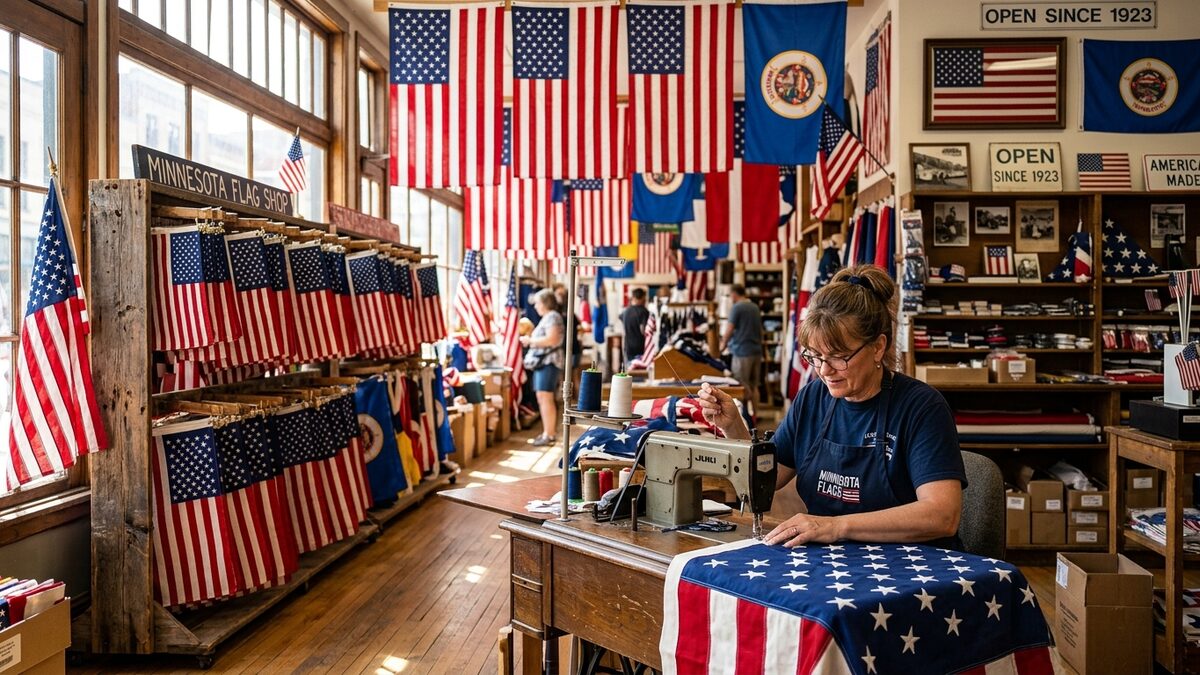
Minnesota’s new legislation mandating that all U.S. flags sold within the state must be American-made by year’s end marks a significant shift in retail and manufacturing policies. With nearly 80 percent of flags currently imported, this law raises important questions about its impact on domestic industry, consumer choice, and supply chains. Exploring the broader implications of this statute reveals the challenges and opportunities ahead for businesses and consumers alike.
Key Takeaways
- Minnesota requires all U.S. flags sold in the state to be made in America by the end of the year.
- The law applies specifically to retail sellers, not individual consumers.
- Nearly 80 percent of U.S. flags sold in Minnesota are currently imported.
- The statute is unique to Minnesota and does not reference federal regulations.
Nearly 80 percent of the more than 500,000 U.S. flags sold annually in Minnesota are currently imported, a statistic that underscores the significance of the state’s new legislation mandating all flags sold within its borders be manufactured domestically by the end of this year.
Overview of the Minnesota Law
The Minnesota law governing the sale of American flags is codified in Minnesota Statutes § 325E.65, titled “Sale of American flags.” This statute explicitly prohibits retailers from selling or offering for sale any American flag within the state unless the flag was manufactured in the United States. The law specifically targets persons “in the business of offering goods at retail,” thereby focusing on retail sellers rather than individual consumers. Notably, the statute does not limit the restriction based on the purchaser’s intended use; the sole criterion is the flag’s country of manufacture. This state-level mandate does not reference any federal regulation or authority, making it a distinct statute applicable only within Minnesota’s jurisdiction.
Nearly 80 percent of the more than 500,000 U.S. flags sold annually in Minnesota are currently imported, a statistic that underscores the significance of the state’s new legislation mandating all flags sold within its borders be manufactured domestically by the end of this year.
Legislative History and Effective Date
The legislation was enacted in 2007 as part of Minnesota’s omnibus state budget package. It became effective on January 1, 2008, marking the date from which compliance was legally required. Contemporary reports at the time, including coverage by Fox News, emphasized that by the end of 2007, all American flags sold in Minnesota stores would need to be American-made, reinforcing the law’s intent to support domestic manufacturing. Subsequent local news sources have reiterated this timeline, consistently treating 2008 as the operative date for enforcement. Since its passage, the law has stood as a clear directive to retailers and suppliers within the state’s borders to source flags domestically.
Enforcement Mechanisms and Penalties
The statute itself does not specify penalties for violations of the flag manufacturing requirement. However, enforcement relies on Minnesota’s default misdemeanor provisions under Minn. Stat. § 609.03, which apply when no specific penalty is articulated by the statute in question. Under this default rule, violations can result in penalties including fines up to $1,000 and imprisonment for up to 90 days. Media reporting has highlighted that while the flag statute lacks a dedicated penalty clause, the broader criminal code provides the legal basis for enforcement actions. Consequently, adherence to the law depends on state authorities’ application of existing misdemeanor penalties to cases of noncompliance by retail sellers.