

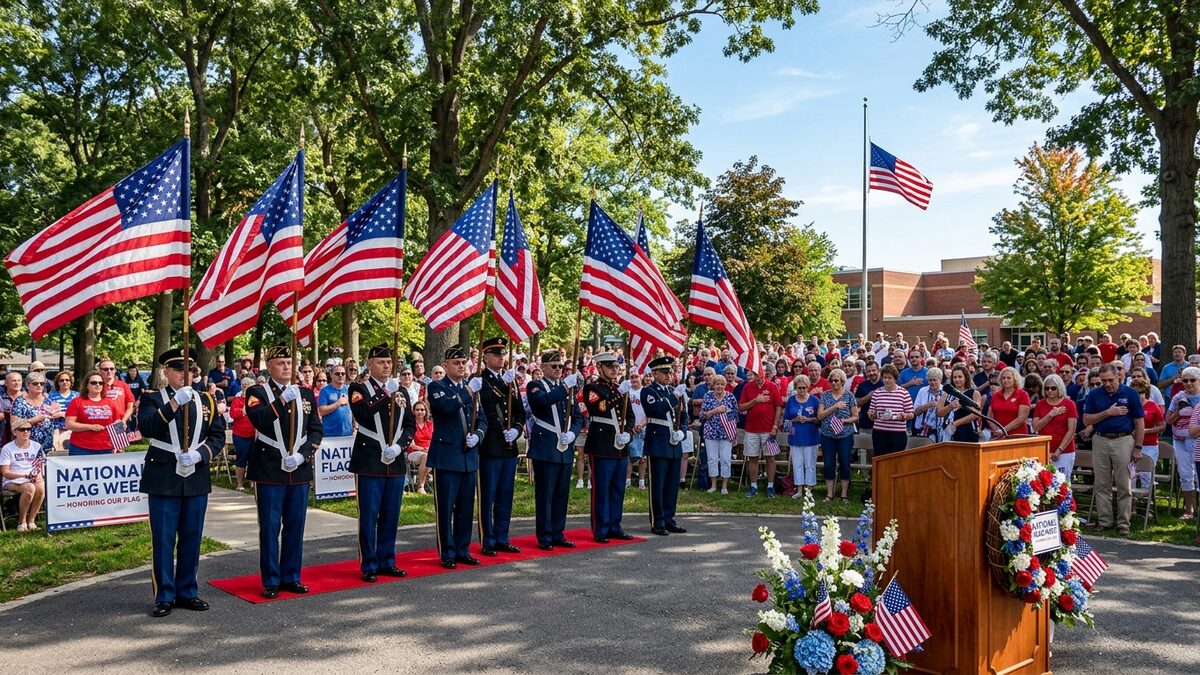
The article explores the rich history and evolving protocols surrounding the American flag, emphasizing its role as a powerful emblem of national unity. It highlights how National Flag Week, established through presidential proclamations, serves not only to honor the flag but also to promote a deeper understanding of the customs and ceremonies that preserve its significance. This focus invites reflection on the flag’s place in contemporary American identity and civic life.
Key Takeaways
- The American flag has symbolized national identity and unity since 1777.
- National Flag Week, established by presidential proclamation, educates citizens on proper flag etiquette.
- The week includes public gatherings and promotes reciting the Pledge of Allegiance.
- Federal buildings are required to display the flag during National Flag Week.
Since the Continental Congress first adopted the Stars and Stripes on June 14, 1777, the American flag has served as a potent symbol of national identity and unity. Over the centuries, evolving rules and proclamations have shaped how the flag is displayed, honored, and preserved, reflecting broader shifts in American society and values. National Flag Week, established by presidential proclamation in the early 20th century, crystallizes this ongoing tradition by dedicating time to educate citizens on proper flag etiquette and to commemorate the flag’s enduring role in American life.
National Flag Week: Federal Observance and Contemporary Significance
National Flag Week is a federally recognized observance that coincides with Flag Day on June 14. Most recently, President Donald J. Trump proclaimed June 14, 2026, as Flag Day and the week beginning that date as National Flag Week. The White House proclamation emphasizes the week’s purpose to honor the nation, celebrate American heritage through public gatherings, and promote the public recitation of the Pledge of Allegiance. Additionally, the proclamation mandates the display of the American flag on all federal government buildings throughout the week, reinforcing the flag’s central role in national identity and public life.
Since the Continental Congress first adopted the Stars and Stripes on June 14, 1777, the American flag has served as a potent symbol of national identity and unity.
The tradition of National Flag Week has deep roots, with similar proclamations preceding the current ones. Notably, President Lyndon B. Johnson issued a proclamation in 1966 designating the week beginning June 12 as National Flag Week. This continuity underscores the flag’s symbolic importance and the federal government’s commitment to fostering patriotic observance among citizens. The public ceremonies and educational efforts during this week highlight the flag not only as a historical emblem but as a living symbol that continues to unite the American people.
Legislative and Executive Foundations of National Flag Week
The formalization of National Flag Week in 1966 marked a pivotal moment in the institutionalization of American Flag Rules, Proclamations, and Ceremonies During National Flag Week. This was grounded in a joint resolution passed by Congress on June 9, 1966, which called upon the President to annually proclaim the week containing June 14 as National Flag Week. Following this legislative request, President Johnson’s proclamation directed government officials to display the flag on all government buildings and encouraged citizens to observe the week by flying the Stars and Stripes at homes and other appropriate locations.
This legislative-executive collaboration established a consistent federal observance that has endured for decades. By linking National Flag Week explicitly to the week of June 14, the government reinforced the historical significance of Flag Day and the flag itself. The resolution and subsequent proclamations also reflect a broader mid-20th-century emphasis on national unity and patriotism amid social and political changes, embedding flag observance within the cultural fabric of the United States.
Federal Guidelines on Flag Display: Respect and Visibility
Alongside symbolic observances, federal guidance on flag display during National Flag Week emphasizes both visibility and respect. The U.S. Army and other authorities provide clear instructions regarding proper flag etiquette to maintain the dignity of the Stars and Stripes. For instance, the flag should not be displayed outdoors in bad weather to prevent damage. Traditional protocol mandates that the flag be displayed only from sunrise to sunset on buildings and stationary flagstaffs unless it is properly illuminated during darkness, in which case it may be flown 24 hours a day.
The manner in which the flag is raised and lowered also carries ceremonial importance. It should be raised briskly to convey pride and lowered slowly or ceremoniously to express reverence. These rules, observed particularly during National Flag Week, ensure that the flag is not merely a decorative element but a respected national symbol. Such guidelines reinforce the solemnity of the flag’s role in American society and provide a framework for citizens and officials alike to honor the flag appropriately during this dedicated week.