

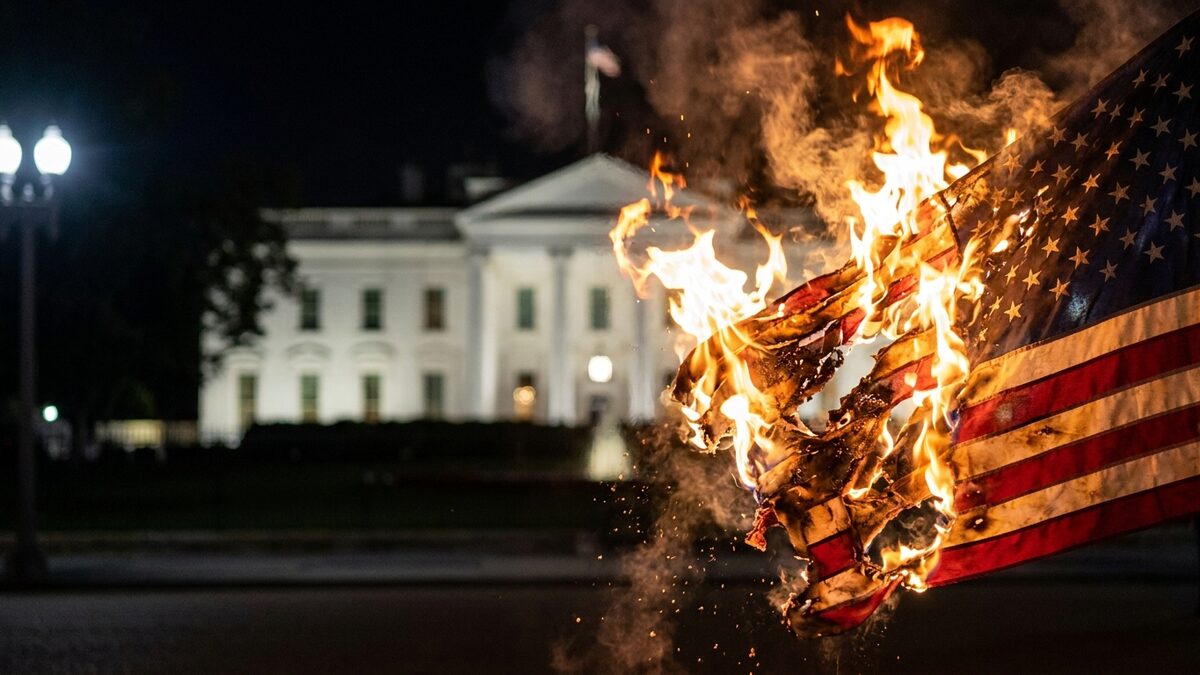
The recent flag burning by Army veteran Jan Carey near the White House has reignited intense debate over the limits of symbolic speech and the meaning of national unity. By directly challenging President Trump’s executive order against flag desecration, this act has brought to the forefront complex questions about patriotism, dissent, and constitutional freedoms. The incident exposes deep societal divisions and compels a critical examination of how America navigates respect for its symbols amid ongoing political polarization.
Key Takeaways
- The burning of the American flag near the White House has reignited debates over symbolic speech and national unity.
- The protester, an Army veteran, burned the flag in opposition to an executive order on flag desecration.
- Authorities charged the protester with fire regulation violations, not the act of flag burning itself.
- The event highlights ongoing tensions about patriotism, dissent, and free expression in the U.S.
What does it mean when the American flag, emblematic of national pride and unity, is set ablaze just steps from the White House? This provocative act has reignited a fierce debate over the boundaries of symbolic speech and the fragility of national cohesion, forcing the nation to confront uncomfortable questions about patriotism, dissent, and the limits of free expression in a deeply divided society.
The Incident in Lafayette Park: A Flashpoint for Protest
On a brisk evening in Lafayette Park near the White House, an American flag was burned by Jan Carey, a 54-year-old Army veteran from Arden, North Carolina. The act was a deliberate protest against President Donald Trump’s recent executive order targeting flag desecration. The protester was detained shortly after the incident at approximately 6:15 p.m. ET and handed over to the U.S. Park Police. Federal prosecutors in Washington, D.C., swiftly filed criminal charges, though the arrest was officially linked to violations of federal park fire regulations rather than the act of flag burning itself.
This provocative act has reignited a fierce debate over the boundaries of symbolic speech and the fragility of national cohesion, forcing the nation to confront uncomfortable questions about patriotism, dissent, and the limits of free expression in a deeply divided society.
This incident, unfolding in a highly symbolic location, underscores the tensions simmering around acts of dissent directed at national symbols. The choice of Lafayette Park—a longstanding site of political demonstration—amplifies the message and the controversy, thrusting the debate over the meaning of the flag and the limits of protest into the national spotlight once again.
Trump’s Executive Order: Redefining Flag Desecration as a Criminal Priority
On August 25, 2025, the White House issued an executive order titled “Prosecuting Burning of The American Flag,” which characterizes the flag as a “special symbol” intended to unite Americans. It labels flag desecration as “uniquely offensive and provocative,” suggesting that such acts can incite violence or riots. The order directs the Attorney General to “vigorously prosecute” those who violate laws protecting the flag, emphasizing the use of “content-neutral laws” and exploring legal avenues to circumvent existing First Amendment protections.
This executive action represents a significant escalation in federal efforts to criminalize flag burning, framing it not merely as a political statement but as a potential threat to public order. By focusing on “content-neutral laws” and exceptions related to “imminent lawless action,” the Trump administration aims to carve out a narrower legal pathway to restrict flag desecration without directly confronting Supreme Court precedents.
Symbolic Speech and the First Amendment: Constitutional Challenges Ahead
The legal foundation protecting flag burning as a form of symbolic speech is rooted in the Supreme Court’s 1989 decision in Texas v. Johnson. The Court held that flag burning constitutes protected expression under the First Amendment, even if offensive to many. Trump’s executive order attempts to navigate around this landmark ruling by emphasizing exceptions for speech that incites “imminent lawless action” or constitutes “fighting words,” categories that have historically been narrowly defined.
Legal experts remain divided on whether these exceptions can withstand constitutional scrutiny when applied to flag desecration. The White House contends that the Court has never extended protection to flag desecration if it threatens violence or public safety, positioning the executive order as consistent with constitutional limits. However, critics argue that this approach risks undermining fundamental free speech protections and deepening national divisions by criminalizing a form of protest that, while provocative, is constitutionally safeguarded.