

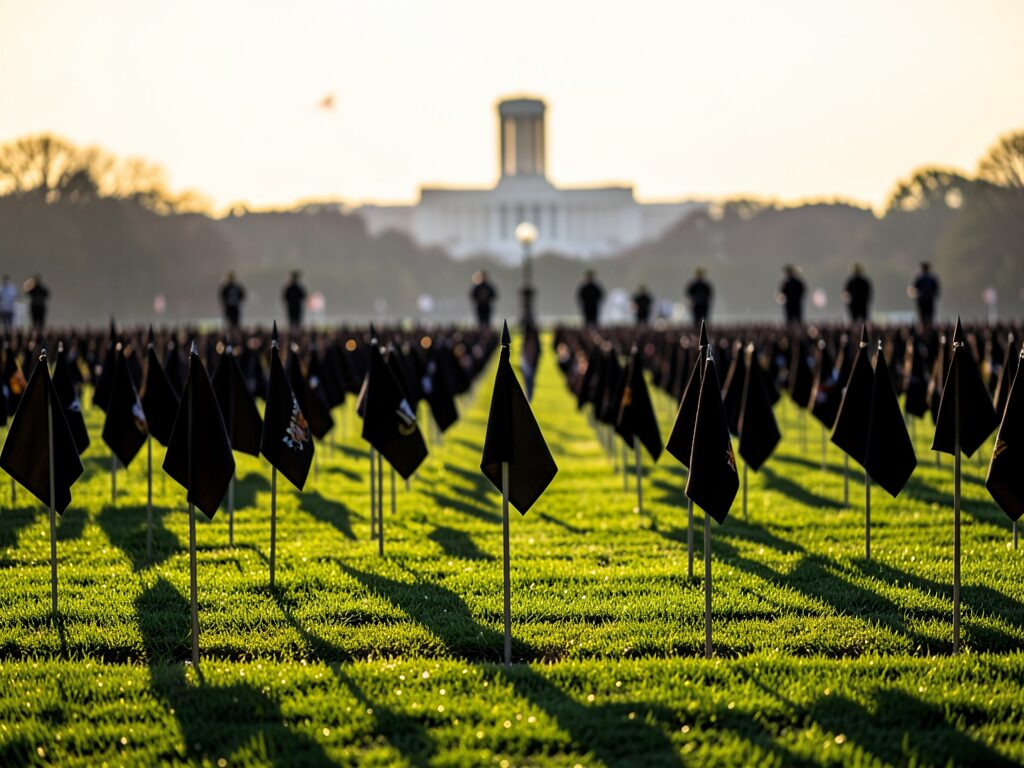
The Pentagon’s renewed commitment to the POW/MIA flag initiative underscores the enduring significance of honoring over 82,000 unaccounted American service members. By mandating the display of the POW/MIA flag alongside the American flag at federal sites, this effort reinforces national recognition and remembrance. This initiative not only reflects respect for the sacrifices made but also emphasizes the ongoing pursuit of closure for families, prompting reflection on the broader implications of such symbolic acts.
Key Takeaways
- The Pentagon is expanding its POW/MIA flag initiative to honor over 82,000 unaccounted American service members.
- The initiative involves displaying the POW/MIA flag alongside the American flag at federal sites, including the Pentagon.
- The POW/MIA flag symbolizes the message “You Are Not Forgotten” and represents the commitment to those missing.
- This effort reflects the government’s dedication to remembering missing personnel and providing closure to their families.
More than 82,000 American service members remain unaccounted for from past conflicts, a stark reminder of the enduring sacrifices made in defense of the nation. In response, the Pentagon has intensified its POW/MIA flag initiative, a solemn effort to honor these missing personnel and ensure their stories remain visible to the public. This initiative seeks to reinforce national commitment to accounting for every individual lost in service, reflecting both respect for the fallen and resolve to bring closure to their families.
The Pentagon’s POW/MIA Flag Initiative
The Pentagon’s POW/MIA flag initiative is a formal effort to display the National League of Families POW/MIA flag alongside the American flag at federal locations, including the Pentagon itself. Originating from the National League of Families of American Prisoners and Missing in Southeast Asia, the flag serves as a powerful symbol bearing the message “You Are Not Forgotten.” This initiative is not merely a commemorative gesture but an official government practice that recognizes the enduring concern for service members who remain prisoner, missing, or unaccounted for. By prominently flying the flag, the Pentagon underscores the nation’s ongoing commitment to honor these individuals and maintain public awareness of their sacrifice.
More than 82,000 American service members remain unaccounted for from past conflicts, a stark reminder of the enduring sacrifices made in defense of the nation.
Legal Foundations Supporting the POW/MIA Flag Display
The display of the POW/MIA flag at federal sites, including the Pentagon, is grounded in federal law. Public Law 101-355, enacted on August 10, 1990, formally recognized the flag as a national symbol of concern and commitment to resolving the fate of POWs and MIAs. This legislative foundation was further strengthened with the passage of the National POW/MIA Flag Act, signed into law by President Donald J. Trump on November 7, 2019. This law mandates that the POW/MIA flag be flown whenever the U.S. flag is displayed at designated federal locations. The bipartisan legislation was introduced by Representatives Chris Pappas and Jack Bergman in the House, and by Senators including Elizabeth Warren, Tom Cotton, Pat Toomey, Marco Rubio, and Jack Reed in the Senate, reflecting broad congressional support for this solemn recognition.
Significance of the 82,000 Unaccounted Service Members
The figure of more than 82,000 unaccounted American service members represents the cumulative number of personnel missing from multiple conflicts, including World War II, the Korean War, Vietnam, the Cold War, and engagements since 1991. This number is maintained and publicized by the Defense POW/MIA Accounting Agency (DPAA) as part of its mission to recover and identify missing personnel. Official statements that include this figure emphasize the ongoing determination of the U.S. government to account for every missing service member. The Pentagon’s continued POW/MIA flag initiative acts as a visible reaffirmation of this commitment, ensuring that the sacrifices of these individuals and the hopes of their families remain at the forefront of national consciousness.